
Why This Course Exists
Many ESRS courses explain what double materiality is.
Very few prepare you for the moment when your conclusions are challenged.
Under the ESRS, double materiality is not a theoretical exercise. It determines:
- Where capital and management attention are allocated
- Which risks are addressed — and which are accepted
- How credible your sustainability strategy is to stakeholders
This course exists for professionals who need to make materiality decisions that are defensible, decision-useful, and value-creating — not just documented.
You will not simply understand double materiality.
You will leave knowing which decisions to take, why they matter, and how to justify them.
Price: £295
You won’t be charged yet
What Makes This Course Different
This programme focuses on decision-useful double materiality, not box-ticking. It is designed for professionals who want to:
-
- Avoid over-reporting and unfocused disclosure
- Concentrate resources where impact, risk, and opportunity create real value
- Produce a credible, defensible materiality outcome that stands up to scrutiny
- Translate ESRS requirements into clear, prioritised next steps
Materiality here is treated for what it really is:
a decision-making filter with strategic consequences.
Our Approach: Value Chain First. Action Always.
We start where ESRS starts: the value chain.
By grounding double materiality in upstream, own operations, and downstream activities, this course shows you how to:
- Identify where actual and potential impacts truly occur
- Distinguish exposure from leverage
- Avoid generic, organisation-centric shortcuts
- Make prioritisation decisions you can explain, evidence, and defend
This ensures your materiality assessment is not only ESRS-aligned — but robust under audit, assurance, and board-level scrutiny.
Double Materiality That Leads to Decisions
Materiality is not an output. It is a decision-making filter.
You will learn how to:
- Apply severity and likelihood logic correctly
- Prioritise when data, time, or resources are constrained
- Use OECD-aligned reasoning to justify focus areas
- Explain why something is material — not just that it is
This is critical for:
- Management buy-in
- Auditor confidence
- Investor credibility
Learning Built Around a Plan of Action
Every concept is linked to what happens next.
All learning is structured around a Plan-of-Action methodology, supported by:
- Practical templates
- Structured handouts
- Guided exercises
- Real-world examples from first-time and advanced reporters
You will clearly see:
- What decisions double materiality enables
- Where action is required
- What information must be gathered next
What This Course Covers
✔️ ESRS double materiality principles
✔️ Impact, risk, and opportunity logic
✔️ Severity & likelihood assessment
✔️ Value-chain-based prioritisation
✔️ Avoiding over-reporting
✔️ Building a defensible materiality narrative
✔️ Linking outcomes to governance, strategy, and disclosures
This course gives you clarity, structure, and direction — before you invest time and money in implementation.
Price:£295
Who This Course Is For
This course is ideal for:
- Sustainability & ESG professionals
- CSRD / ESRS leads
- Consultants supporting first-time reporters
- Internal audit, risk, and compliance teams
- Professionals preparing for GRI Certification
Especially valuable if you are:
- A first-time ESRS reporter
- Revisiting materiality after an initial weak assessment
- Preparing for external assurance
- Trying to align sustainability with business strategy
Why Learn with FBRH
This course is delivered by one of the first GRI Certified Training Providers,
with over two decades of experience helping organisations:
- Navigate complex sustainability requirements
- Avoid unnecessary reporting burden
- Focus on value-creating disclosures
- Build trusted, high-quality reports
Our approach is consistently praised for being:
✔️ Practical
✔️ Structured
✔️ Honest
✔️ Action-oriented
We don’t just teach standards. We teach how to use them.
Certification & Recognition
- This is a GRI and CPD Certified Course
- Contributes toward preparation for GRI Certification
- Includes structured learning aligned with ESRS expectations
- Recognised globally by sustainability professionals and employers
What You Will Be Able to Do After This Course
By the end of the course, you will be able to:
- Conduct a value-chain-based double materiality assessment
- Prioritise impacts, risks, and opportunities with confidence
- Defend your materiality outcomes to stakeholders and auditors
- Avoid over-reporting and misalignment
- Clearly identify next steps for implementation
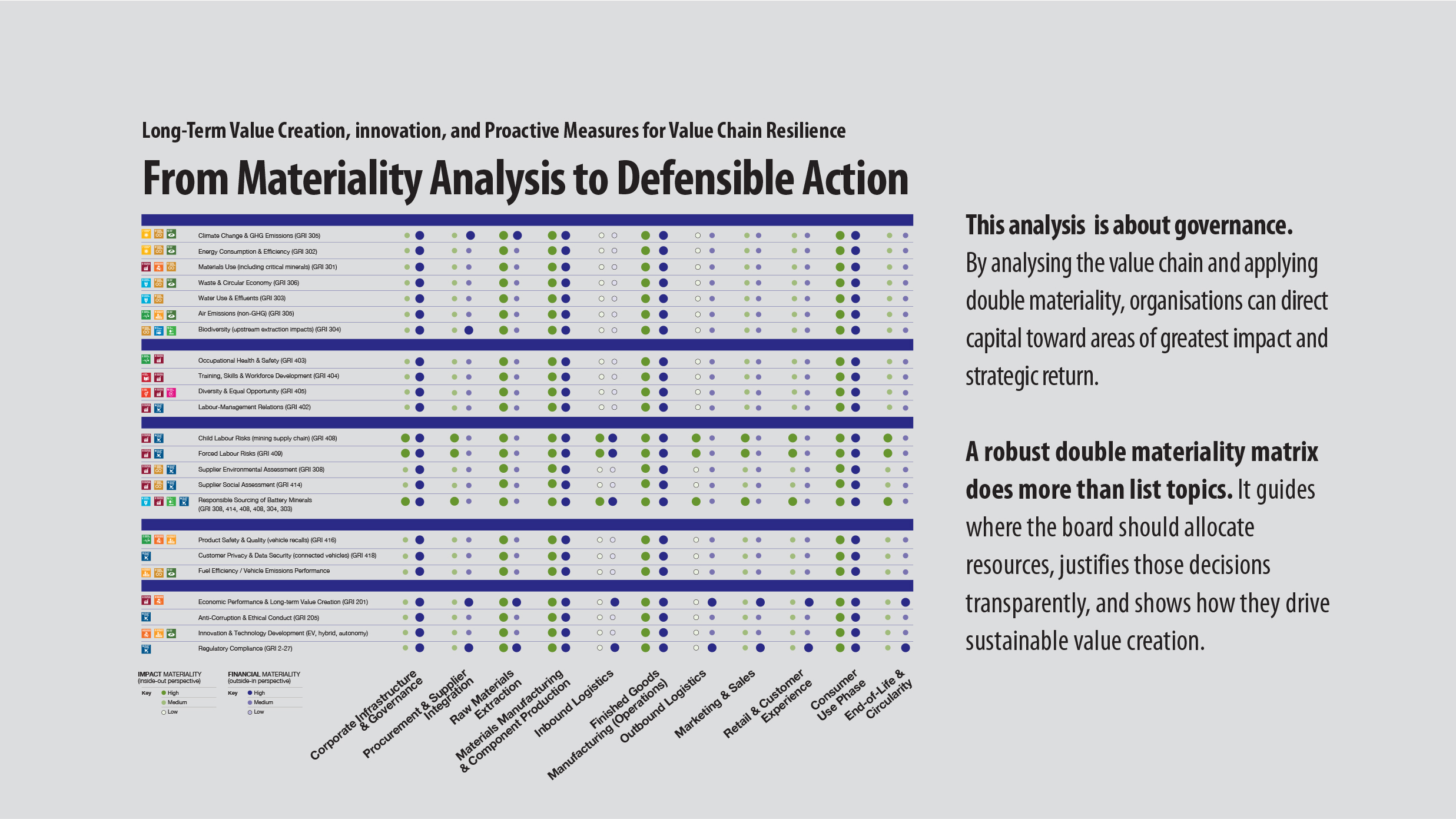
A properly constructed double materiality matrix does more than identify topics.
It shows where a company should act, why those decisions are justified, and how they create value.
By mapping impacts, risks, and opportunities across the value chain, this approach helps organisations focus effort where it matters most, avoid unfocused reporting, and take decisions they can confidently defend.
When done properly, double materiality becomes a strategic tool — guiding short-, medium-, and long-term action that creates competitive advantage, builds stakeholder trust, and delivers value for the business, society, and the planet.
Ready to Bring Clarity to Double Materiality?
If you want certainty, structure, and a clear plan of action —
this course is your starting point.
Enroll now and move from materiality confusion to materiality confidence.
Price:£295
Value-Chain-Based | Decision-Focused | Built for Defensible Outcomes

Stop treating double materiality as a reporting exercise. Start treating it as a business decision you will have to defend.
AI can generate options.
It cannot choose what you must stand behind when auditors, regulators, boards, or investors ask “why did you prioritise this?”
This GRI Certified course is designed for professionals who must take responsibility for double materiality decisions — and use those decisions to create business value, stakeholder trust, and real-world impact.
Price
£295
Don’t start your report without first understanding the key elements that make it strategic—not just compliant.
Course Features
Trainer
Simon is an experienced trainer and combines communication and ESG /Sustainability expertise. This enables him to teach in a clear and practical way course material and empower participants to take sustainability action ASAP. We provide each and every participant with a clear road-map/ practical plan of action. This is assessed in group exercises with clear group tasks to help ensure that you complete the course and are able to go forward immediately.
- MBA Marketing (Oxford Brooked University)
- University of Cambridge business course
“Sustainable Finance”
“Sustainable Supply Chain Management” - GRI Certified ESRS Sustainability Professional
- GRI Certified Sustainability Professional
- Fellow of the Chartered Institute of Marketing (FCIM)
- Fellow of the Institute of Sustainability and Environmental Professionals (FISEP)
- Editor www.sustaincase.com
- Member of the Chartered Institute of Journalism (CIoJ)
- GRI Nominated trainer
- ISEP trainer
Free Mock Exam
Exclusive
Free FBRH mock exam
Reinforce the knowledge you have gained with the FBRH mock exam.
Free access for all full academic path participants.
Check your GRI knowledge with this free sample.
200+ REVIEWS ★★★★★
"You can know nothing about GRI
Standards and in 2 days you will be
ready to advise clients or run a
reporting project for your company."
Laurence Cox
(Salterbaxter, an MSL Company)
“Thanks for two excellent days of
learning How to Create a 1st-Class GRI
Standard Sustainability Report"
Anette Brøto Nereng
(KPMG Norway)
Linkedin post
“Pleased to share that as of today I am a GRI
Certified Sustainability Professional. Great
course, thank you for the insights and
unique learning path”
Ting Chaung Ho
(S&P Global)
Linkedin post
Blog
www.sustaincase.com
Building a proactive and sustainable world, together
Identify > Measure > Manage > Change.
How are others addressing SDGs?
Simply click on an SDG goal below to see related case studies. Case studies for every SDG The navigation tool below has been designed to assist …
FBRH Consultants UK: campaign to support the launch of a GRI Education Sector Standard
Building a proactive and sustainable world, together Positive change does not come through wishful thinking. Our busy and complicated world…
How are others creating shared value
Shared Value is a business strategy concept introduced by Michael Porter that focuses on creating economic value while also addressing social…
How are others addressing GRI topic specific disclosures?
Simply click on a GRI topic below to see related case studies. Case studies for every GRI topic standard The navigation tool below has been designed …
Becoming a GRI Certified Sustainability Professional
Full academic preparation by FBRH, a GRI Global Certified Partner This is a specially curated collection of informative articles on the Global Reporting…
The European Sustainability Reporting Standards and GRI
50,000 EU & non EU businesses will need to publish sustainability information This is a specially curated collection of informative articles…